Isaac Newton
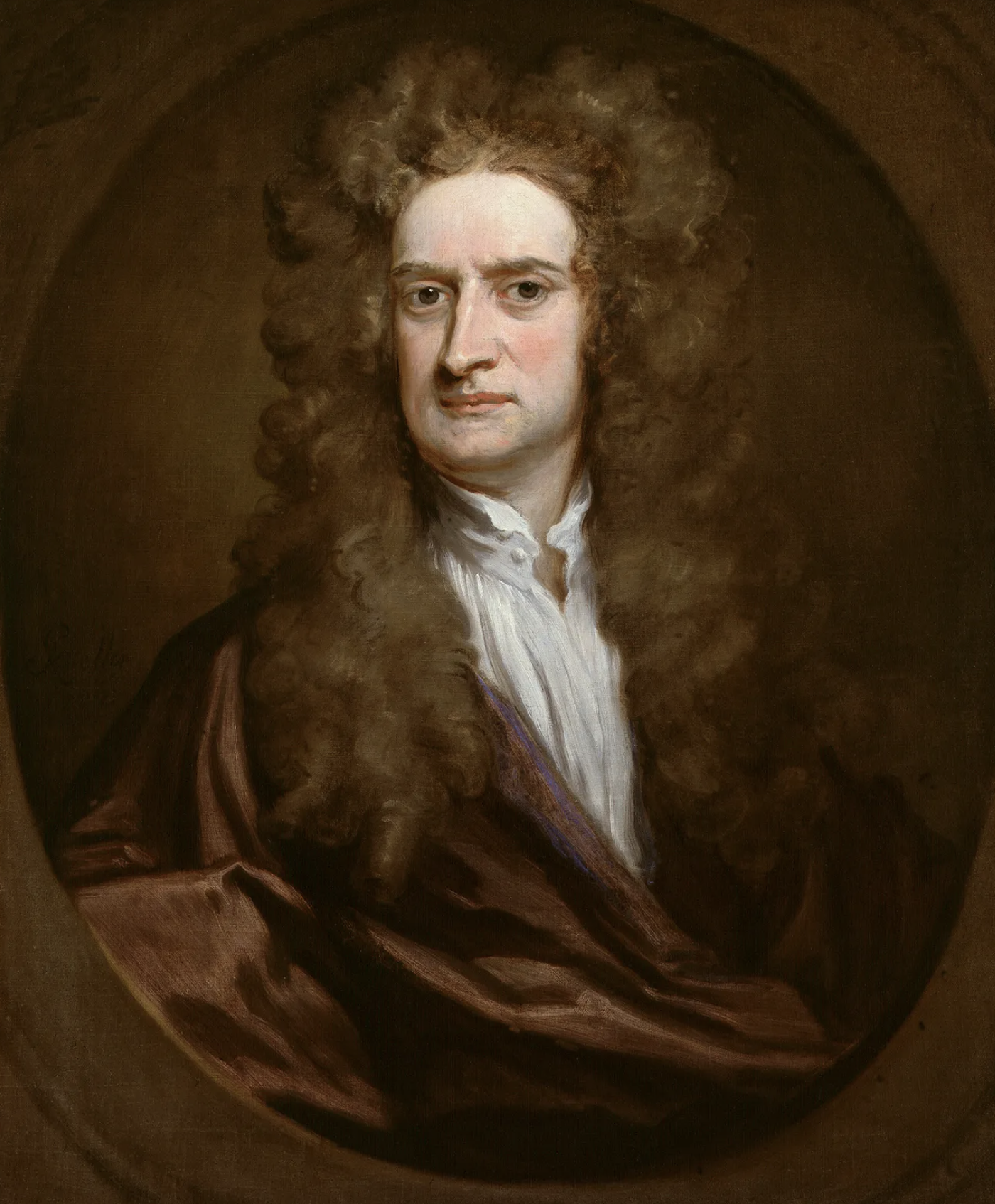
Isaac Newton was born on January 4, 1643 in England. He studied at the University of Cambridge in 1665, but had to take a break from his schooling due to an outbreak of the bubonic plague. Around this time, the infamous apple fell on Newton’s head, prompting him to “discover” gravity. This momentous idea became the foundation of Newton’s Laws of Motion.
Newton went back to Cambridge in 1667, but this time not as a student. He was a professor for about 2 years before returning back to his own individual studies, which he much preferred. In his prime, Newton not only formulated the basis of physics, but also many branches of math, such as Calculus. He developed the ideas of integration and differentiation, fundamental principles in higher level math.
In 1671, Newton reinvented the telescope, this time with mirrors. By reflecting light, he was able to make a much more powerful tool than anything before it. Fun fact, Newton’s idea of mirroring is still used today in some of the world’s most powerful and complex telescopes.
After spending his time lurking in the shadows of science, Newton finally published his work in 1687: Principia Mathematica. His ideas were held in high regard, even though many at the time had no idea what he was talking about. It wasn’t until decades to centuries later that people could truly understand the brilliance of Newton’s ramblings.
Image Credit: Britannica
Out of his fame, Newton actually entered the world of politics and economics. He fixed Britain’s forgery issue as the Master of Mint and became a member of Parliament. In 1703, he became president of Britain’s Royal Society (a high distinction for scientists).
On March 20th, 1727, Newton died in his sleep at the age of 84. He was buried in Westminster Abbey. Newton’s legacy lives on with his unique ideas being taught in every physics and math class.
If you are interested in learning more about Rosalind Franklin, explore the resources below: